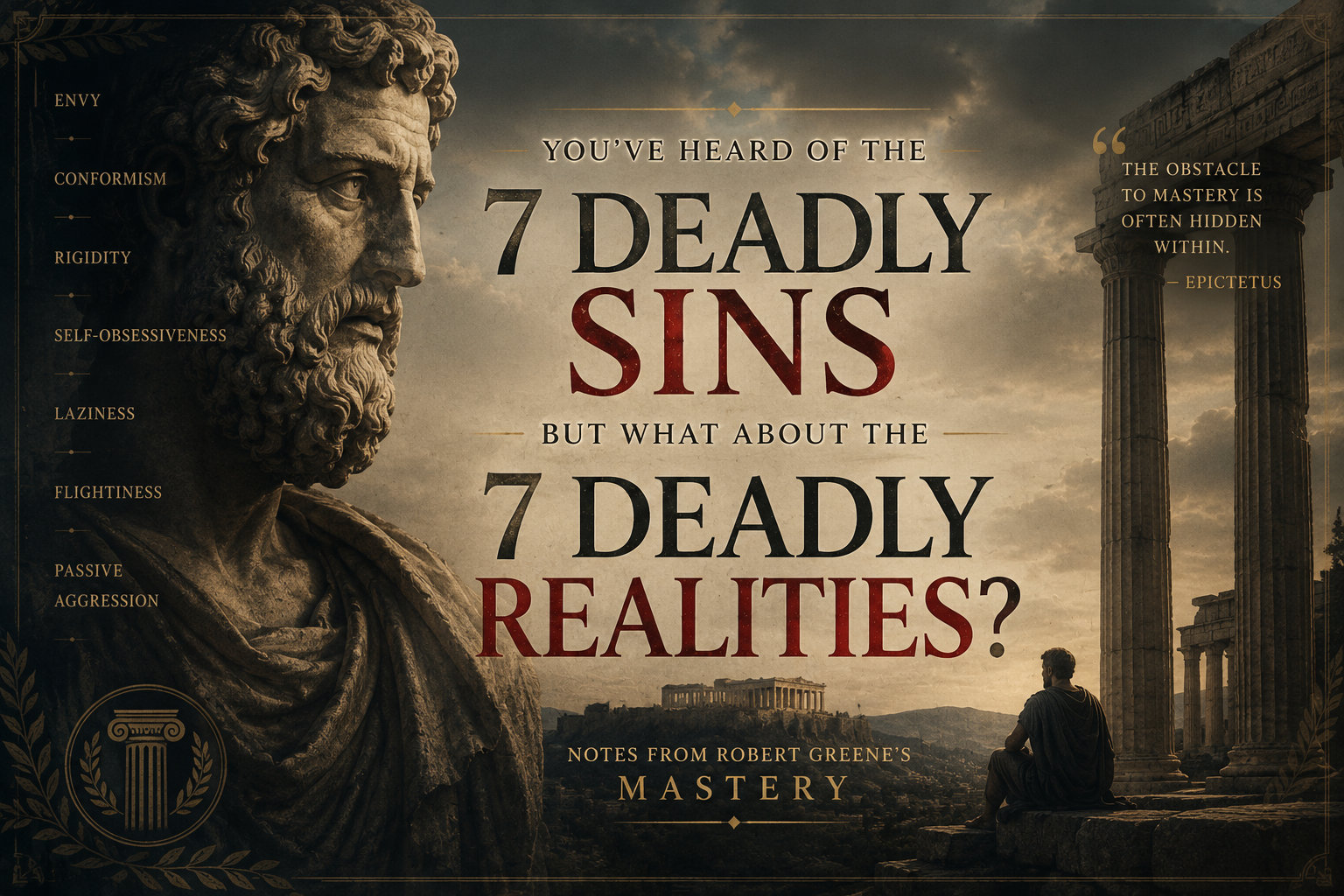
You've Heard of the 7 Deadly Sins. But What About the 7 Deadly Realities?
You’ve Heard of the 7 Deadly Sins. But What About the 7 Deadly Realities?
These are my notes from the chapter 4 of book Mastery by Robert Greene.
The Seven Deadly Sins warn against moral corruption.
The Seven Deadly Realities are behaviors that quietly corrupt your path to mastery. They answer a different question, not “What makes a person bad?” but rather, “What makes a person fail?”
The Difference
Seven Deadly Sins
Moral flaws that corrupt the soul.
It asks:
“What makes a person bad?”
Seven Deadly Realities
Human behaviors that corrupt your path to mastery.
It asks:
“What makes a person fail?”
1. Envy
You compare your progress to others.
Their success feels like your failure.
But envy blinds you.
Instead of learning from people ahead of you, you secretly resent them.
Mastery requires admiration, not bitterness.
2. Conformism
You follow the crowd because it feels safe.
You copy what everyone else is doing.
You avoid standing out.
You trade originality for approval.
But mastery begins when you stop asking,
“Will they accept me?”
and start asking,
“What is truly mine?”
3. Rigidity
You cling to old ideas, old methods, and old identities.
You refuse to adapt because change threatens your ego.
But the world keeps moving.
The master stays fluid.
Rigidity makes you break. Flexibility lets you grow.
4. Self-Obsessiveness
You make everything about you.
- Your needs.
- Your problems.
- Your image.
- Your emotions.
But when you are trapped in yourself, you cannot truly see others.
Mastery requires social intelligence.
You must understand people as they are, not as your ego wants them to be.
5. Laziness
Laziness is not always doing nothing.
Sometimes it is:
- Thinking shallow.
- Choosing shortcuts.
- Avoiding discomfort.
- Wanting results too soon.
You want mastery, but resist the apprenticeship.
Real growth requires repetition.
Patience.
Discipline.
Boredom.
The lazy mind wants the prize. The master loves the process.
6. Flightiness
You jump from one thing to another.
- New goal.
- New identity.
- New obsession.
- New distraction.
You start with excitement, but quit when it gets boring.
Mastery demands depth.
You cannot master what you keep abandoning.
7. Passive Aggression
You hide anger behind silence, sarcasm, delay, or fake politeness.
Instead of being direct, you sabotage quietly.
This destroys trust.
Mastery requires clear communication, emotional control, and honesty.
What you refuse to face directly will control you indirectly.
Reflection
The Seven Deadly Sins warn you about moral corruption.
The Seven Deadly Realities warn you about practical failure.
Sometimes the greatest obstacle to mastery is not a lack of talent.
It is:
- envy
- Conformity
- Rigidity.
- Ego
- Laziness.
- Distraction
- Hidden resentment
Recognizing these behaviors is the first step toward overcoming them.
Mastery begins with seeing yourself clearly.
TL;DR
- Envy makes you compare instead of learn.
- Conformism trades originality for approval.
- Rigidity prevents adaptation.
- Self-Obsessiveness limits your understanding of others.
- Laziness seeks shortcuts instead of apprenticeship.
- Flightiness prevents depth and consistency.
- Passive Aggression destroys trust and communication.
Mastery begins with seeing yourself clearly.